

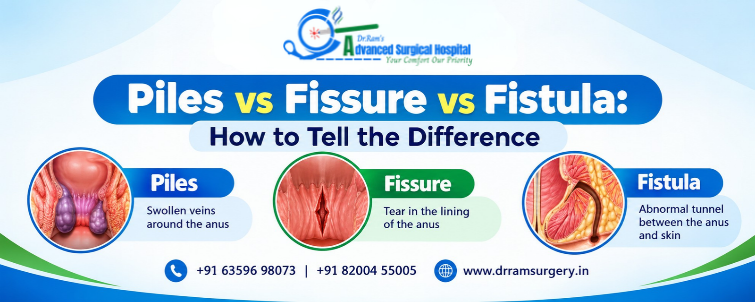
Piles vs Fissure vs Fistula: How to Tell the Difference
Experiencing pain, swelling, or bleeding in the lower rectal region can be both physically uncomfortable and emotionally distressing. Because symptoms like localized pain, spotting, or discomfort during bowel movements often overlap, many people struggle to figure out what is actually causing their distress. When faced with these issues, one of the most common questions patients ask is how to differentiate between piles vs fissure vs fistula.
While all three conditions affect the same anatomical area, they are distinct medical issues with different causes, physical characteristics, and management strategies. Understanding the distinction between piles vs fissure vs fistula is an important first step in recognizing warning signs, avoiding improper self-treatment, and seeking appropriate care. At Dr. Ram Advance Surgical Hospital, patients frequently arrive after enduring weeks of discomfort simply because they were unsure of the cause or felt hesitant to discuss rectal health. Gaining clarity on piles vs fissure vs fistula can help clear up misconceptions and guide you toward a timely medical evaluation.
What Are Piles?
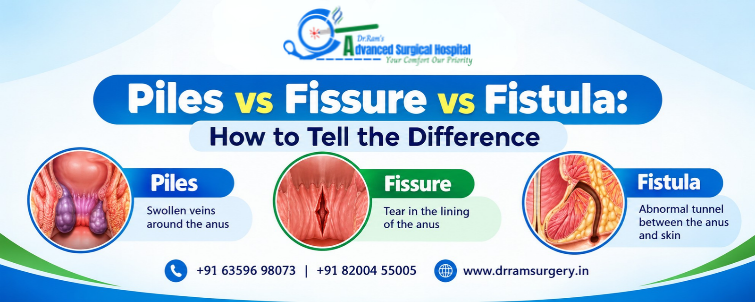
Piles, medically known as hemorrhoids, are swollen or inflamed blood vessels situated inside the rectum or around the anal opening. Similar to varicose veins in the legs, these vascular cushions expand, bulge, and stretch when subjected to increased pelvic pressure.
Common Causes of Piles
- Persistent straining during bowel movements
- Chronic constipation or frequent bouts of diarrhea
- Prolonged sitting, particularly on the toilet
- Heavy lifting or chronic coughing
- Increased intra-abdominal pressure during pregnancy or due to natural aging
Typical Piles Symptoms
- Painless Bleeding: Seeing bright red blood on toilet paper, in the toilet bowl, or coating the surface of stool.
- Swelling or Soft Lumps: Feeling soft, localized swellings around the anal region.
Anal Itching and Irritation: Persistent moisture or localized inflammation around the skin.
Internal vs. External Piles
- Internal Piles: Positioned deep inside the rectum, these hemorrhoids are generally invisible and rarely cause pain because the internal rectal lining lacks pain-sensing nerve fibers. However, straining can cause them to bleed or push through the anal opening (prolapsed piles).
- External Piles: Formed under the sensitive skin surrounding the anal opening, external piles can cause noticeable discomfort and swelling. If a small blood clot forms inside an external hemorrhoid (a thrombosed hemorrhoid), it can cause sudden, severe pain.
When evaluating piles vs fissure vs fistula, recognizing whether your primary symptom is painless bright red bleeding or soft swelling offers useful context for your healthcare provider.
What Is an Anal Fissure?
Unlike piles, which involve swollen vascular tissue, an anal fissure is a small tear, split, or open crack in the thin mucosal lining of the anal canal. It behaves like an open wound on sensitive skin.
Common Causes of Anal Fissures
- Passing hard, dry, or bulky stools
- Bouts of frequent or severe watery diarrhea
- Excessively tight or spastic anal sphincter muscles, which reduce blood flow to the tissue
- Localized trauma during childbirth or inflammatory bowel conditions
Typical Anal Fissure Symptoms
- Sharp, Tearing Pain: Experiencing severe, cutting pain during bowel movements.
- Lingering Burning Sensation: Feeling an aching or burning pain that persists for minutes or even hours after leaving the restroom.
- Minor Bleeding: Noticing small streaks of bright red blood on toilet paper or on the surface of the stool.
Why Bowel Movements Are So Painful
The anal opening is controlled by strong muscular rings known as sphincter muscles. When a tear occurs, the passage of stool stretches the exposed wound, triggering intense pain. This pain causes the internal sphincter muscle to contract into an involuntary spasm. The spasm starves the delicate lining of optimal blood supply, which slows down healing and keeps the painful cycle repeating with each subsequent bowel movement.
Comparing piles vs fissure highlights a clear distinction: while uncomplicated internal piles rarely hurt, an anal fissure almost always presents with sharp, memorable pain tied directly to bowel movements.
What Is an Anal Fistula?
An anal fistula is an abnormal, infected tunnel or channel that connects an internal gland inside the anal canal to an external opening on the skin surrounding the anus.
How an Anal Fistula Develops
Most anal fistulas originate from a clogged anal gland located just inside the anus. When this gland becomes infected, it forms a localized collection of pus known as an anal abscess. If the abscess bursts on its own or is drained without complete healing of the underlying channel, a persistent tunnel can remain behind—creating an anal fistula.
Typical Fistula Symptoms
- Persistent Discharge: Continuous or intermittent drainage of pus, foul-smelling fluid, or blood onto underwear.
- Throbbing Ache: A persistent, dull, or deep ache in the anal region that worsens when sitting, walking, or coughing.
- Recurrent Swelling and Heat: Localized redness, tenderness, and recurring swellings near the anal opening.
- Skin Irritation: Soreness and itching caused by constant fluid exposure on surrounding skin.
- Fever or Chills: Systemic symptoms that occur if an active collection of fluid becomes trapped.
When evaluating piles vs fissure vs fistula, remember that a fissure is a superficial mucosal tear, whereas a fistula is an underlying infected passage.
Piles vs Fissure vs Fistula: Key Differences
To help you compare piles vs fissure vs fistula at a glance, the table below outlines their primary features:
| Feature | Piles (Hemorrhoids) | Anal Fissure | Anal Fistula |
| Primary Cause | Increased pelvic pressure, straining, constipation, sitting | Passing hard stools, chronic diarrhea, high sphincter muscle tone | Clogged anal gland, unhealed or drained anal abscess |
| Typical Symptoms | Soft swelling, painless bleeding, anal itching | Sharp cutting pain during stool passage, lingering burn | Persistent pus discharge, throbbing pain, recurrent bumps |
| Pain Pattern | Usually painless (internal), unless thrombosed (external) | Sharp, severe pain during bowel movements; lingering burn | Constant, dull, or throbbing pain; worse when sitting |
| Bleeding | Bright red blood dripping into bowl or coating stool | Small streaks of bright red blood on toilet paper | Occasional blood mixed with pus or persistent fluid |
| Discharge | Minimal to none | Minimal to clear fluid | Recurrent or persistent pus, foul-smelling drainage |
| Swelling / Lump | Soft vascular bulge or firm thrombosed lump | Rare; chronic cases may form a small skin tag | Firm, tender, inflamed opening or bump near the anus |
| Usual Diagnosis | Clinical history, visual inspection, anoscopy | Visual inspection, gentle physical examination | Clinical inspection, probing under care, imaging (MRI/USG) |
| General Treatment | Fiber, sitz baths, ointments, minimally invasive procedures | Fiber, stool softeners, muscle-relaxing ointments, minor procedures | Specialist evaluation, procedural or surgical repair |
Understanding these distinctions in piles vs fissure vs fistula shows how varied their physical manifestations truly are.
How Doctors Diagnose These Conditions
Attempting self-diagnosis when considering piles vs fissure vs fistula can be inconclusive. Symptoms frequently overlap, and it is entirely possible for a person to experience more than one condition simultaneously—such as having both piles and an anal fissure at the same time.
A professional medical evaluation ensures an accurate diagnosis through structured steps:
- Medical History Review: Discussing bowel patterns, dietary habits, symptom duration, and the precise nature of any pain or bleeding.
- Visual Inspection: Gently examining the outer anal skin to check for external hemorrhoids, visible mucosal splits, or external fistula openings.
- Digital Rectal Examination (DRE): A careful manual assessment to evaluate muscle tone, feel for internal swellings, or identify areas of tenderness.
- Anoscopy or Proctoscopy: Using a brief, illuminated diagnostic instrument to view the lower rectal lining clearly without discomfort.
- Advanced Imaging: In cases involving deep, complex, or recurrent fistula channels, an MRI or specialized ultrasound may be advised to map the precise path of the tract before planning care.
Seeking a timely clinical exam at a dedicated facility like Dr. Ram Advance Surgical Hospital removes guesswork and prevents unnecessary delays in relief.
Treatment Options for Piles, Fissures, and Fistulas
Management strategies vary depending on whether you are facing piles, a fissure, or a fistula, as well as the severity of your symptoms.
1. Management for Piles
- Conservative Measures: Increasing daily fiber intake, maintaining hydration, taking warm sitz baths, and applying recommended topical ointments to soothe irritation.
- Minimally Invasive Procedures: Outpatient options such as rubber band ligation or sclerotherapy for internal hemorrhoids that continue to bleed or prolapse.
- Surgical Options: Minimally invasive surgical techniques or traditional hemorrhoidectomy reserved for advanced, non-responsive, or severely thrombosed external piles.
2. Management for Anal Fissures
- Conservative Care: Using stool softeners, increasing dietary fiber, using warm sitz baths, and applying prescribed muscle-relaxing topical ointments (such as nitroglycerin or calcium channel blocker gels) to ease sphincter spasms and improve blood flow.
- Procedural Care: For chronic fissures that do not respond to conservative management, minor interventions—such as localized injections or a minor procedure called lateral internal sphincterotomy (LIS)—may be evaluated to reduce muscle tension and permit complete healing.
3. Management for Anal Fistulas
Unlike piles or fissures, an anal fistula rarely resolves with medication or lifestyle adjustments alone because the underlying channel continues to receive fluid and bacteria.
- Specialist Assessment: Treatment focuses on clearing or closing the infected passage while carefully preserving the surrounding sphincter muscles responsible for bowel control.
- Surgical & Procedural Care: Options range from a fistulotomy (opening the tract to allow healing from inside out) and seton placement to advanced laser fistula procedures, tailored specifically to the complexity and path of the channel.
Evaluating piles vs fissure vs fistula highlights why personalized, condition-specific treatment is essential rather than relying on generalized over-the-counter remedies.
When Should You See a Doctor?
While mild rectal irritation can occasionally improve with temporary dietary changes, certain symptoms require professional evaluation by a healthcare provider or colorectal specialist:
- Persistent or Severe Anal Pain: Pain that interferes with sitting, sleeping, walking, or daily activities.
- Recurrent Rectal Bleeding: Regular blood loss, whether painful or painless.
- Pus or Foul Discharge: Any continuous drainage on underwear or surrounding skin.
- Recurrent Swelling or Tender Masses: Bumps near the anal opening that grow, fail to resolve, or recur in the same spot.
- Fever and Chills: Systemic signs that point toward an active infection or trapped abscess.
- Unresponsive Symptoms: Discomfort lasting longer than a few days despite increased water and fiber intake.
If you experience any of these warning signs, scheduling a consultation at Dr. Ram Advance Surgical Hospital ensures your condition is thoroughly evaluated by trained medical professionals.
How to Reduce the Risk of Recurrence
Adopting healthy daily habits supports smooth bowel function, reduces pelvic pressure, and minimizes the risk of recurring anorectal issues:
- Eat Sufficient Dietary Fiber: Include plenty of whole grains, legumes, fruits, and fresh vegetables in your daily meals to keep stools soft and well-formed.
- Maintain Good Hydration: Drink plenty of water throughout the day to prevent hard, dry stools that require straining.
- Avoid Straining on the Toilet: Do not force bowel movements or hold your breath while trying to pass stool.
- Respond Promptly to Urges: Avoid delaying toilet visits when you feel the natural urge to pass stool.
- Limit Time Spent Sitting on the Toilet: Avoid prolonged sitting while reading or browsing smartphones, as this posture increases venous pressure in the lower rectum.
- Stay Physically Active: Regular daily movement, such as walking, promotes healthy bowel motility and helps prevent chronic constipation.
- Practice Gentle Anal Hygiene: Wash the area gently with plain water after bowel movements and pat dry carefully rather than rubbing with dry toilet paper.
Integrating these preventative steps into your routine provides long-term digestive support regardless of your history with piles vs fissure vs fistula.
Frequently Asked Questions (FAQs)
1. Can an anal fissure turn into piles or an anal fistula?
An anal fissure does not directly turn into piles. However, a long-standing chronic fissure can lead to the formation of a small skin tag near the tear, known as a sentinel pile. Furthermore, if a chronic fissure becomes severely infected or if a nearby anal gland fills with pus, it can potentially lead to an anal abscess, which may subsequently develop into an anal fistula.
2. Is bright red blood always a sign of piles?
While bright red blood is a classic indicator of internal piles, it is not exclusive to them. An anal fissure also frequently causes bright red blood streaking on toilet paper or stool due to the open tear. Because rectal bleeding can occasionally stem from other gastrointestinal conditions, any unexplained or recurring rectal bleeding should be formally evaluated by a doctor.
3. Can dietary changes completely cure an anal fistula?
Dietary modifications such as increasing fiber and drinking more water are very helpful for managing piles and allowing acute anal fissures to heal by softening the stool. However, lifestyle and dietary adjustments alone are generally insufficient to heal an established anal fistula. Because a fistula is an abnormal, lined tunnel under the skin, it typically requires specialized evaluation and procedural management to close completely.
4. How does pain differ between piles vs fissure?
The pain characteristics of piles vs fissure are distinctly different. Uncomplicated internal piles are usually completely painless, though external piles can cause a dull ache or sharp pain if a clot forms (thrombosis). In contrast, an anal fissure causes severe, sharp, or cutting pain directly during a bowel movement, which is often followed by a lingering burning sensation that lasts for several hours.
5. Can I have more than one of these conditions at the same time?
Yes, it is entirely possible to experience more than one anorectal condition simultaneously. For instance, chronic straining from hard stools can cause both internal piles to swell and an anal fissure to tear at the same time. This overlap in symptoms makes clinical evaluation at a specialized facility like Dr. Ram Advance Surgical Hospital crucial for getting an accurate diagnosis.
Conclusion
Understanding the major distinctions between piles vs fissure vs fistula empowers you to recognize symptoms early and seek appropriate medical care. While piles involve swollen vascular tissue, anal fissures represent open tears in the anal mucosal lining, and anal fistulas are infected tunnel channels requiring specialized management. Because symptoms like bleeding, discomfort, and swelling frequently overlap, attempting self-diagnosis can delay effective relief.
If you are experiencing persistent pain, bleeding, or unusual discharge, consider seeking a professional medical consultation at Dr. Ram Advance Surgical Hospital. A thorough evaluation ensures an accurate diagnosis and a clear, medically responsible path toward comfort and recovery.
Tags: piles vs fissure vs fistula, Dr. Ram Advance Surgical Hospital, difference between piles and fissure, difference between piles and fistula, fissure vs fistula, piles symptoms, anal pain and bleeding, treatment for piles, rectal bleeding causes